SIBI is an AI powered personal assistant designed to make SIBS’ extensive data easier to access and understand.
By combining conversational AI with SIBS Cloud, the platform enables internal users to ask questions in natural language and quickly access relevant business insights, supporting more informed, data driven decisions.


SIBS has an extensive data ecosystem that can enable the development of new products and services. However, for this data to create value, it first needs to be structured, organized, and governed effectively. I worked with the Data & Advanced Analytics department, whose goal was to establish this data governance. As part of this initiative, we developed SIBS Cloud on Azure, powered by AI. A centralized environment bringing together SIBS’ existing and future data. By making this data easier to access, share, and consume, the platform enables SIBS internal teams to build a deeper understanding of the business and its history. This, in turn, helps identify new opportunities, support better decisions, and ultimately drive revenue.
Create an AI-powered platform that gives SIBS users access to the cloud through a conversational interface. Users can interact with the platform like a generative AI assistant, asking questions in natural language and receiving fast, accurate answers based on SIBS’ data. Essentially, the solution becomes a SIBS AI personal assistant, making complex business data easier to access, understand, and use.
UX/UI & Product designer
Department director, Product manager, Product owner, Key users, Development team (Al & Machine learning), Cloud engineers and Tester.
Starting by research
Over the past decade, intelligent assistants have become increasingly prominent as companies such as Apple, Google, Amazon, and Microsoft invested in developing more sophisticated conversational AI. These technologies are changing how people interact with technology, becoming seamlessly integrated into everyday life. As AI powered personal assistants are still an emerging technology, I first explored what they are, how they work, and how users interact with them. These assistants are virtual software agents designed to support users with tasks and provide information through AI technologies. They combine natural language processing (NLP), machine learning, and other AI techniques to understand user inputs and respond in a human-like way, making complex tasks more automated and accessible. Extracting ideas.

Understanding user needs.
To identify where an AI assistant could have the greatest impact, I started by speaking with real users and surveying the heads of SIBS departments. The goal was to understand their needs, challenges, and opportunities for improvement.
The insights gathered helped identify and prioritize the areas where AI could improve operational efficiency, support employees, and enhance the quality of internal and customer facing services.

In a total of 28 departments’ participation and after iterating about all of the replies, we decided to proceed with the Operations and Customer Service Department, specially focused on the last one. We understood that an AI Assistant could significantly support the Customer Service Staff at SIBS by simplifying responses, reducing resolution time, and improving service quality. The AI provides instant access to procedures, suggests accurate replies, helps triage tickets, and ensures consistent, 24/7 support. This can really boost efficiency in the department, enhancing customer satisfaction, and supporting agents in handling complex digital payment issues with greater confidence.
Defining Target
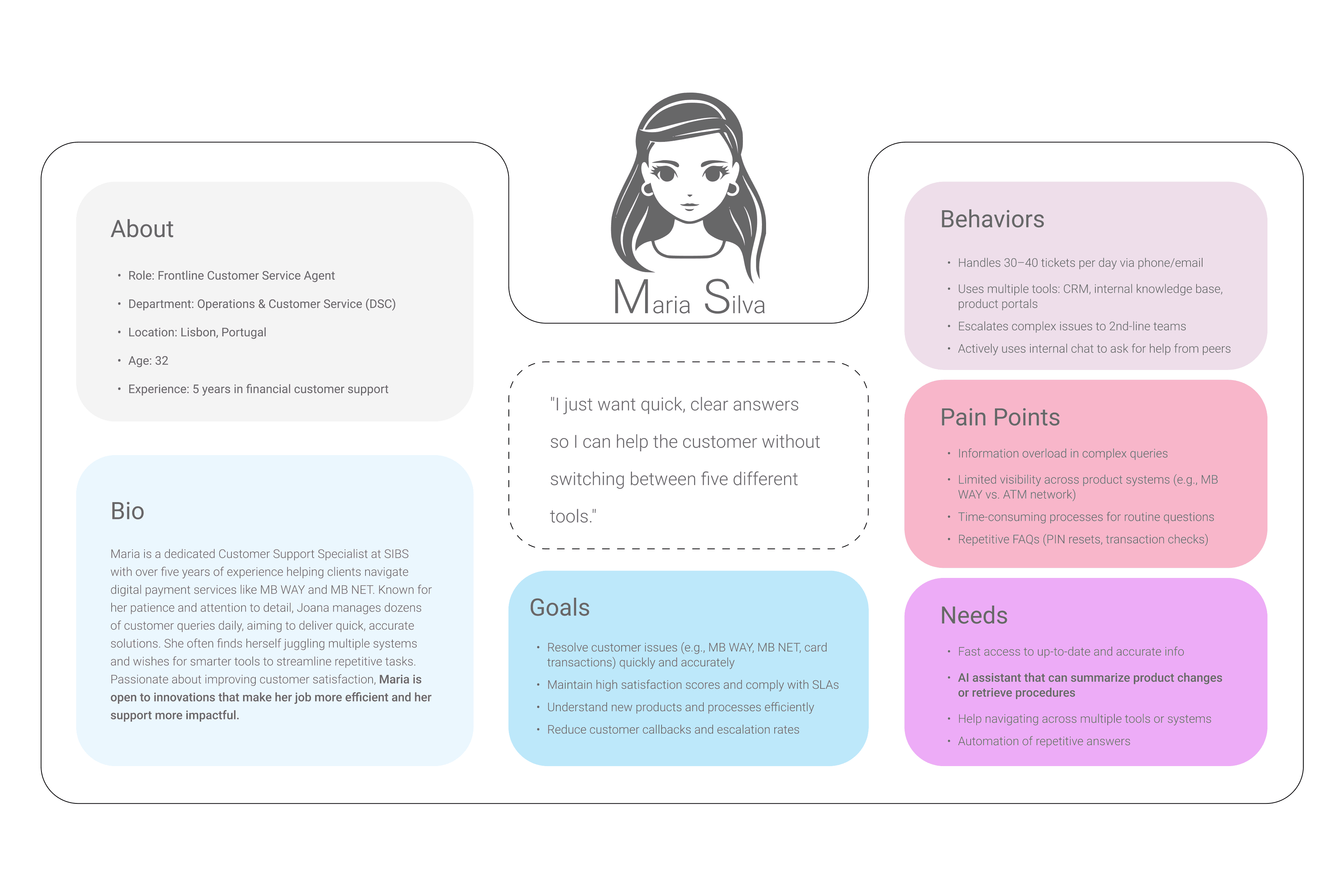
We went to meet our focus users - Customer Service Staff at SIBS - and after a couple of workshop/empathy sessions, we understood their users profile. The Primary Objective is to provide efficient, secure, and customer-focused support for SIBS products and services, especially MB WAY, MB NET, ATM/POS issues, and merchant services. Here is a detailed vision of our users:

To help us understand a little more about the users and iterate, we created a proto persona, where we could direct the efforts and pains based on the data of the initial interview and workshops. This persona helped to better base and understand what the users’ motivations would be and how to align what the product could deliver as a result.
Deciding what to build
Collecting more insights
After connecting with the users I felt the need to research more and get inspired about AI Assistants in the market, to understand the trends, the user experience side of them, as interactions, colors and the general UI. I explored products like ChatGPT, Google Gemini, Microsoft Copilot and Apple Siri and all share common UX/UI principles that reflect modern conversational AI design. Their interfaces are built for simplicity and clarity, typically using clean layouts, minimal distractions, and clear visual feedback. All of them embed privacy and transparency elements into the UI, such as data usage notices, source citations (like in Gemini or Copilot), or chat history management (like in ChatGPT), helping build trust through clear communication.
Crafting AI Identity
It was time that our virtual companion came to life, and for that we had to focus on what kind of emotions should it impact on the users, especially in terms of tone, empathy, and trust-building. As for the identity we wanted a more feminine and ladylike personality, more in tone with a more cooperative financial world like SIBS. An AI that expresses a calm, warm, and capable personality, adapting emotional tone based on the user’s needs — without pretending to have emotions itself. The right emotional tone makes the experience more human-centered, trustworthy, and usable. Here are the core emotions or emotional expressions SIBS’ AI assistant should be able to simulate through its responses:


Introducing SIBI
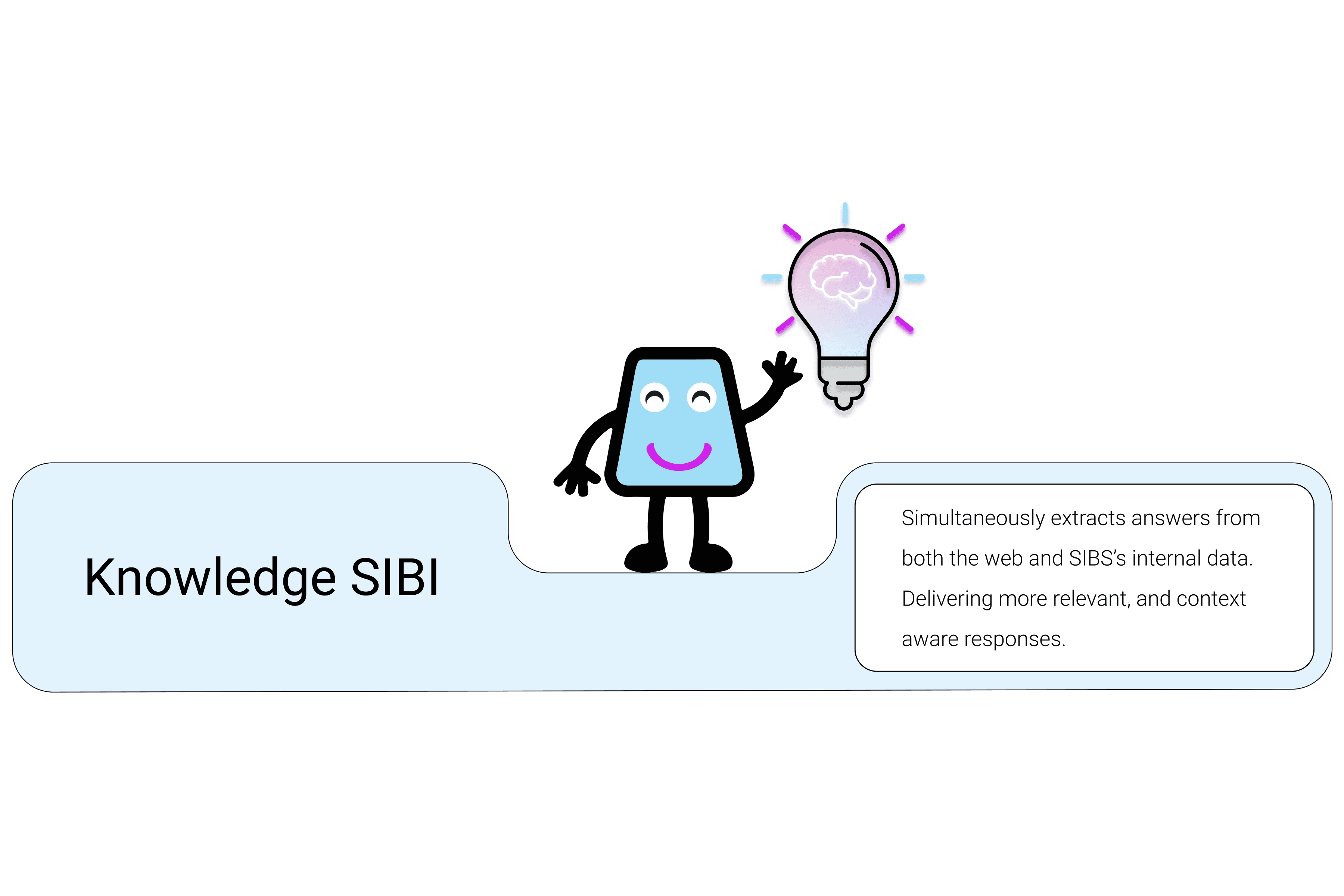
And so, SIBI was born. Multinho's cheerful companion and SIBS's intelligent Al assistant. Designed to guide users through both SIBS's internal knowledge and the wider web, SIBI wants to bring warmth and efficiency to every interaction. With this dual nature, SIBI offers a balance between wide accessibility and deep institutional insight. SIBI comes with two distinct modes:

DESIGNIG THE SOLUTION
Structuring the product
To elevate the user experience beyond smooth conversations with SIBI - the Al assistant's core function, we worked directly with users to uncover additional features that would add more value. These co creation sessions led to key insights about what tools and enhancements would make SIBI more helpful. Below are the main conclusions from this collaborative exploration.

Initial sketches
I started by sketching the first wireframes, which allowed me to quickly explore ideas and visualize potential features. Then, I translated those sketches into digital wireframes. This process helped clarify which screens I wanted to showcase and sparked valuable discussions with the team about what made the most sense for the user experience.

Building the interface
After testing the wireframes with users, I quickly moved into designing the full set of mockups and their navigation. I followed a consistent design system aligned with SIBS branding, while introducing new colors to define SIBI’s own visual identity. One of the key challenges was ensuring that SIBI felt present throughout the entire experience - always there to guide and support users.

Visual identity
To reflect SIBI’s cheerful and feminine personality, we introduced soft shades of pink and light blue - carefully chosen to align with SIBS’s existing brand guidelines.
Inspired by Multinho’s origins in the 1980s, SIBI’s visual aesthetic draws from iconic digital games of that era, like Tetris, Pac-Man, and Nintendo classics.
In tribute to those early digital environments, black was used prominently, anchoring the design with a bold and nostalgic tone. The contrast between light and dark colors was a deliberate choice to enhance visual accessibility and ensure readability for all users.

Prototype
The prototype brings the SIBI experience to life, showing how users can navigate the platform and access different ways of interacting with SIBS’ knowledge.
From the AI assistant and Knowledge Chats to the Knowledge Forum and personalised settings, the prototype explores a unified experience for accessing information, asking questions, sharing knowledge, and managing the way SIBI works.
It also helped validate the navigation, interaction patterns, information architecture, and overall visual language before moving towards development.

